The 7 Best Check Scanners
Updated by · How we research

Speed, resolution, endorsing and bank support separate these seven single-feed and batch check scanners. The Digital Check CheXpress CX35 comes first. When users buy our independently chosen editorial recommendations, we may earn commissions to help fund the Wiki.
Before buying a check scanner, ask your bank which models its deposit service supports. The scanner images both sides of a paper check and reads its magnetic routing and account line, so a business can deposit checks through its bank's remote deposit service without visiting a branch. Small offices, landlords, churches and bookkeepers use them.


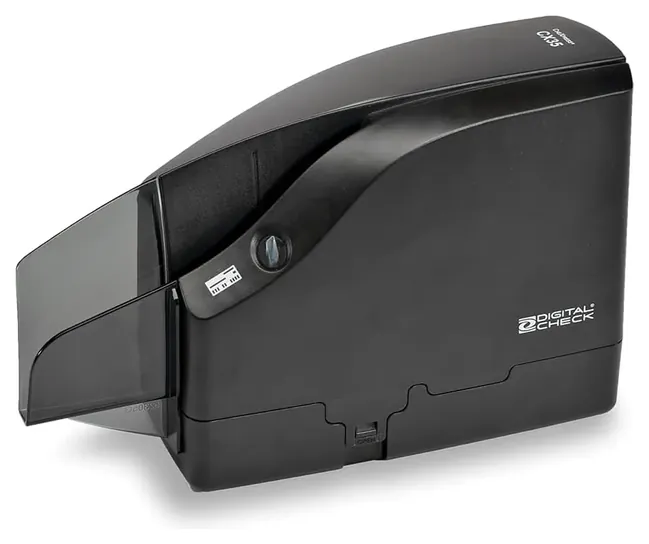
From the manual
- Open the rear exit door before launching the software to pass checks straight through; up to five stack there, and a franker won't work. p. 8
- The light turns blue when cleaning is due, about every six months or 10,000 checks; three quick button presses start the card-cleaning cycle. pp. 11, 15
- Inkjet versions ship with a cartridge that lasts six to 12 months once opened; keep a spare, and never shake or drop it. pp. 2, 18
- Windows 11 and 10 are supported; for a Mac or Linux, Digital Check asks you to call its support about versions. p. 19
Why the Digital Check CheXpress CX35 is our top pick
For the office that deposits a few dozen checks on a busy day, the CX35 matches the bigger scanner where the deposit is decided: the image and the magnetic read. Its sensors capture both sides at 600 dpi, the same as our runner-up, the Digital Check TellerScan TS250, and both read U.S. and European check fonts magnetically.1,3 Reynolds Business Systems puts single-feed scanners at up to about 200 checks on a typical busy day.5
What our pick adds is a smaller footprint: it is about two inches narrower than the runner-up and a pound lighter.1,3 Its maker calls it the direct successor to the CX30, which it bills as the best-selling check scanner of all time.2 Upkeep is the same on both: a status light that signals when cleaning is due and a three-press automatic card-cleaning cycle.1,3 UMB's bank list names both, though only in network mode, which on the CX35 means buying its network version.6
The trade-off is speed and capacity. The TS250 loads 100 checks, stacks 150 and runs 55 to 120 a minute depending on the version,3,4 while the CX35 takes one check at a time at up to 30 a minute.1 If your busy days run past a couple hundred checks, buy the runner-up instead.
| Digital Check CheXpress CX35 | Digital Check TellerScan TS250 | |
|---|---|---|
| Feeding | One check at a time | Stack of up to 100 |
| Rated speed | Up to 30 a minute | 55 to 120 a minute by version |
| Exit capacity | 5, pass-through mode only | 150 |
| Image sensors | 600 dpi, both sides | 600 dpi, both sides |
| Size and weight | 3.92 in wide, 3.72 lb | 5.93 in wide, 4.7 lb |
Sources
- Digital Check CheXpress CX35 1User manual, Rev F (PDF), pp. 1, 18, 11, 15, 19 2Launch announcement, May 2024
- Digital Check TellerScan TS250 3User manual, Rev G (PDF), pp. 1, 17, 13, 18 4Brochure, Portuguese (PDF), p. 3
- 5Reynolds Business Systems: check scanner buyer's guide
- 6UMB: remote deposit scanner requirements (PDF)
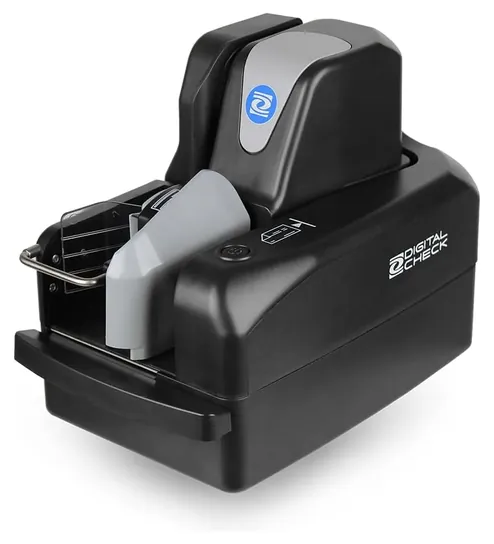
From the manual
- For network mode, power it up before connecting the USB cable, then reboot; the light shows purple instead of blue. p. 10
- Digital Check supplies only an optional USB driver and its ScanLite2 test tool, through support or its website; the scanning software comes from your bank. p. 7
- A slow purple flash means 10,000 checks have passed and a cleaning card is due; the separator pad has three sides to rotate before replacement. pp. 13-14
- The front slot scans standard-size ID cards, but not embossed ones. pp. 9, 18
Compare the specs
Swipe the table sideways to see every column.
| Product | Feeder (checks) | Top speed (checks/min) | Exit pocket (checks) | Resolution (dpi) | Endorser |
|---|---|---|---|---|---|
| 1. Digital Check CheXpress CX35 | 1 (hand-fed) | 30 | 5 (pass-through) | 600 | Optional inkjet |
| 2. Digital Check TellerScan TS250 | 100 | 55, 75 or 120 by version | 150 | 600 | Optional inkjet |
| 3. Panini Vision X | 1, 50 or 100 by version | 50, 75 or 100+ by version | 100 | 300 | Inkjet or none by version |
| 4. Digital Check TellerScan TS240 | 100 | 50 to 150 by version | 100 | 300 | Optional 1- or 4-line inkjet |
| 5. Epson CaptureOne | 1 (hand-fed) | 30 | 100 | 200 | Electronic, plus franker |
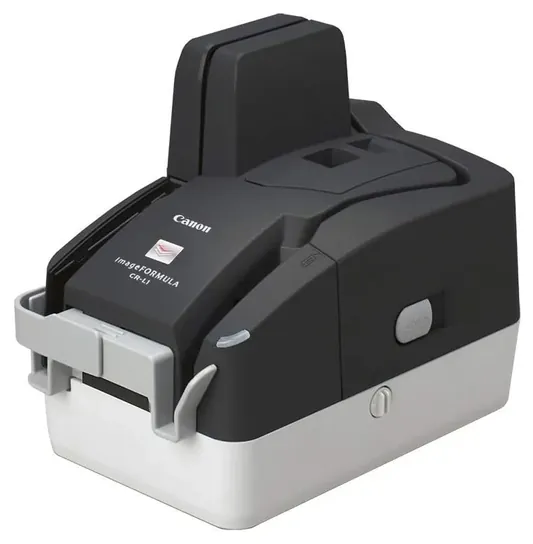
| 6. Canon imageFORMULA CR-L1 | 50 | 45 (20 in color) | 50 | 300 | Built-in 1-line printer |
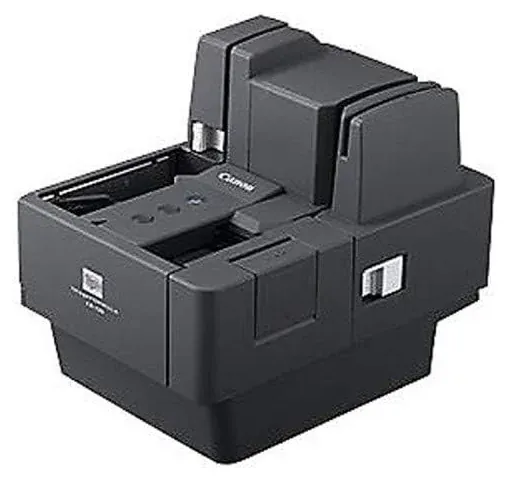
| 7. Canon imageFORMULA CR-120N | 150 | 120 | — | 600 | Built-in 5-line printer |
Speeds are the makers' top ratings; several models come in slower and faster versions, so check the label or listing for yours.
Sources
- Digital Check CheXpress CX35 User manual, Rev F (PDF) Brochure, 2026 (PDF)
- Digital Check TellerScan TS250 User manual, Rev G (PDF) Brochure, Portuguese (PDF)
- Panini Vision X Operator manual, 2015 (PDF)
- Digital Check TellerScan TS240 User manual, French-Canadian (PDF)
- Epson CaptureOne TM-S1000 spec page Spec page, Spanish (Epson Peru) Setup sheet (PDF)
- Canon imageFORMULA CR-L1 Brochure, Canon Canada (PDF)
- Canon imageFORMULA CR-120N Brochure, French, Canon Canada (PDF)
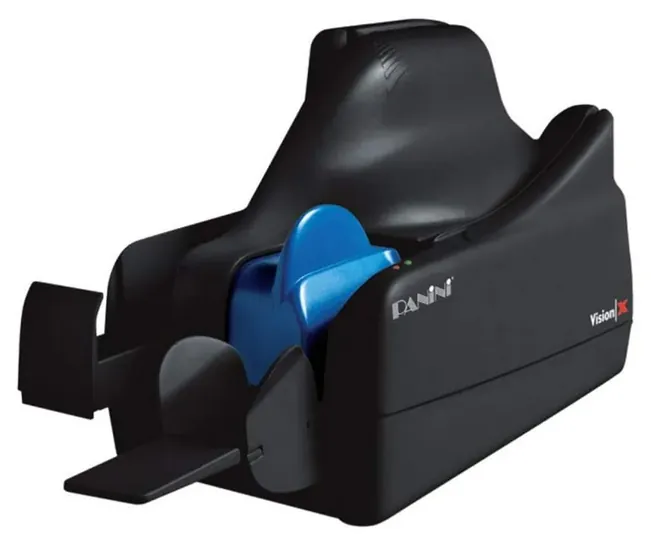
From the manual
- Speed and the inkjet endorser are software upgrades, so a 50-a-minute unit can later be raised to 75 or 100-plus. pp. 39-40
- The 50-check small-feeder version stops after 50 checks in a row with a warning; reload and restart the software to continue. p. 24
- Panini recommends cleaning it weekly, or as your volume needs; green stickers mark the parts you're meant to touch. p. 29
- This 2015 edition lists only Windows XP through 8, so ask your bank for its current Windows 10 or 11 driver. p. 43
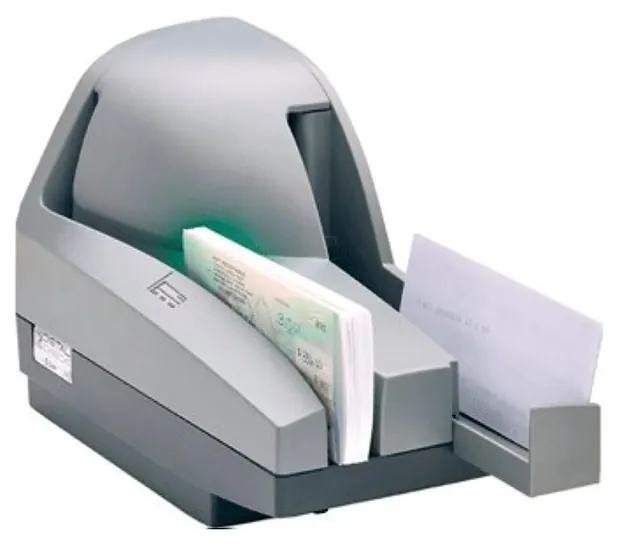
From the manual
- There's no power switch: it turns on when the USB cable meets a running computer and shuts off with it. p. 4
- Clean every 8,000 to 10,000 scans with Digital Check cards and pads, and blow dust from the track's middle toward both trays. pp. 19, 24
- The roller that separates checks pulls out without tools and is user-replaceable, mostly needed on busy or long-serving units. p. 22
- The warranty covers one year or four million scanned documents. p. 25
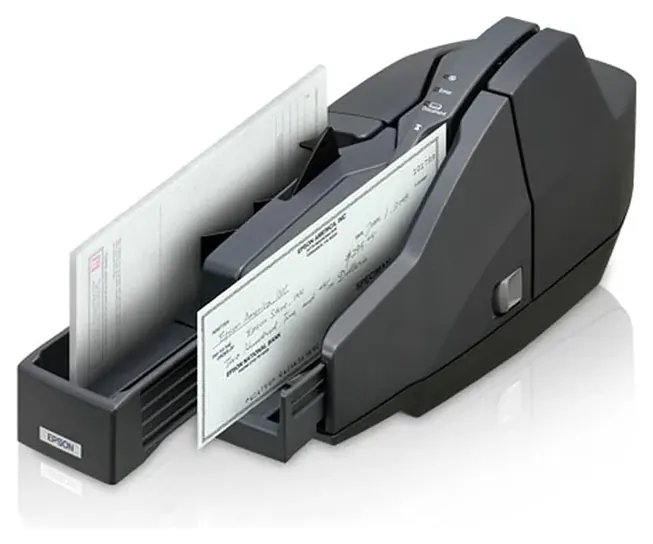
From the manual
- Run the TM-S1000 Utility, which installs the USB driver, before connecting the scanner; if Windows' new-hardware wizard appears, cancel it. p. 1
- On single-feed models, insert the next check only after the last one ejects; two at once can jam or misfeed. p. 1
- The franker, which stamps scanned checks, takes its own ink cartridge: use genuine Epson ones before the date on the box, away from children. p. 1
Editor's Notes
November 5, 2026, by Ezvid Wiki Editors:
We read the manuals and spec sheets for all seven scanners and added a spec table, a section on why the CX35 leads and notes from five manuals. We corrected the guide on Check 21, which makes a paper substitute check, not a scan, the legal equivalent of the original, and on sizing a scanner. We dropped unconfirmed claims that Canon stopped making the CR-L1 and CR-120N, and we note the TS240's expected retirement in 2026 and the CaptureOne's successor.
October 19, 2026, by Ezvid Wiki Editors:
Our new first pick, the Digital Check CheXpress CX35, replaces the CheXpress CX30, a single-feed scanner banks have long listed for remote deposit, and it costs less. The old list had aged badly. The Canon CR-190i II and the Epson TM-S2000 have been discontinued or replaced, and the Epson TM-S9000 is no longer sold. We dropped the MagTek MICRSafe because it only reads the magnetic line on a check. It takes no picture, so it can't make a deposit. The Burroughs Elite and the SmartSource Micro Elite went because we couldn't find maker documents to back up their specs.
The Panini Vision X, the Digital Check TellerScan TS240 and the Canon imageFORMULA CR-120N stay. New are the CX35, the Digital Check TellerScan TS250, the Epson CaptureOne and the Canon imageFORMULA CR-L1. Stock of the two Canon models varies by reseller; each entry says so.
Two cautions. Ask your bank which scanners its deposit service supports before you buy anything. That list matters more than any spec here. And the evidence is thin. We found no independent tests of check scanners, and two maker sites wouldn't load for us, so we relied on maker documents, bank support guides and dealer spec sheets.
Earlier notes
January 27, 2021, by Christopher Thomas:
There's been essentially zero new developments to checking technology recently, which is understandable, because except in certain professional scenarios, not a ton of people use checks anymore. For that reason, the Panini Vision X remains our top choice, while the versatility of the Epson TM-S2000 has elevated it to our top spot. For pure, high-volume check reading all day long, the Canon ImageFormula CR-120N is a highly viable solution, and for just scant check payments, the CheXpress CX30 and especially the MagTek MICRSafe offer plenty of functionality, at reasonable prices.
November 15, 2019, by Christopher Thomas:
Smaller companies may not need to go all-out in a check scanner; if you're not going through hundreds per day, the Panini Vision X is worth a look, as it's very popular and there are a number of upgrades and attachments available for it. Similarly low-priced is the CheXpress CX30, while modern small-business owners may also be intrigued by the multifunctional MagTek MICRSafe. And if desk space is at an absolute premium, the SmartSource Micro Elite may be all you need, although like some other inexpensive models it does not have a built-in printer. On the other hand, if you deal with a lot of paperwork besides checks, you might consider (also or in addition) a traditional document scanner or even one designed with a sheet-fed loading mechanism.
The Canon CR-190i II and Epson TM-S9000 are both heavily geared toward large organizations, and they're able to fulfill a number of tasks including ID verification that less-complex models cannot. Plus, they operate at significantly higher resolutions than most; they are, however, extremely expensive.
In the middle of the pack are the Canon ImageFormula CR-120N, Epson TM-S2000, TellerScan TS240 and SmartSource Pro Elite. These can often do many of the things that the corporate-focused machines can, they just can't do them nearly as many times per day. The Canon is an especially nice model thanks to its 600-DPI resolution, while the Epson allows for 15 printing lines which is far more than most of the rest.
Special Honors
Digital Check UV Scanners Digital Check makes versions of the CheXpress CX35 and TellerScan TS250 that add an ultraviolet image to the normal scan, which helps tellers and back offices spot altered or counterfeit checks. They're sold through dealers rather than as everyday listings, and Digital Check also publishes cleaning guides and sells cleaning cards for its scanners. digitalcheck.com
Single-Feed Or Batch: Size For A Typical Busy Day
At 30 a minute, 2,000 checks take about 67 minutes of feeding by hand.
Check scanners come in two types. A single-feed scanner takes one check at a time, and the fastest run about 30 a minute. A batch scanner, also called multi-feed, holds a stack in a hopper and pulls them through on its own, usually at 50 to 120 a minute. Reynolds Business Systems suggests sizing the scanner to a typical busy day, not the busiest day of the year: single-feed for up to about 200 checks, a teller-class batch scanner at 50 to 75 a minute for 200 to 1,000, and a back-office model at 100 to 150 a minute beyond that.
The math is simple. At 30 a minute, 2,000 checks take about 67 minutes of feeding by hand. At 100 a minute, they take about 20, and you can do something else while the hopper empties. For a landlord or small shop with a few dozen checks a week, a single-feed model is smaller, cheaper and quieter. Beyond speed, Teksetra weighs software compatibility, franking, support and network connection when choosing between the two types.
Hopper size matters as much as speed. The TellerScan models hold 100 checks and the Canon CR-L1 holds 50, while the Panini Vision X takes 50 or 100 depending on which feeder version you buy. A bigger hopper means fewer refills on a big deposit day.
Your Bank's Scanner List Comes First
A check scanner doesn't deposit anything by itself. It feeds images and the magnetic line to your bank's remote deposit capture service, usually through a browser helper or small program the bank supplies. Each bank supports a set list of scanners, and an unlisted model may not connect at all. The Remote Deposit Now hardware guide lists the CheXpress CX30, TellerScan TS240, Panini Vision X and I:Deal, Epson CaptureOne and SmartSource Professional for Windows, but not the newer CX35 or TS250. UMB's scanner list names those two only in network mode, which on the CX35 means buying its network version. Your bank's list may differ, so ask before you buy.
Every model here reads MICR, the magnetic ink line at the bottom of a check. U.S. checks use the E-13B font, a standard since the 1960s; CMC-7 is common in Europe. Reading the ink magnetically means stamps or smudges over the numbers don't spoil the read, and every character the scanner misses becomes a reject someone has to key in by hand (Reynolds). A flatbed or document scanner can't read magnetic ink, which is why it won't work for remote deposit.
Resolution matters less than it looks. Makers quote 200 to 600 dpi, but your bank's image rules decide what passes. Accounting software such as QuickBooks doesn't talk to the scanner either: you deposit through the bank and then match the deposit in your books. Budget for the extras too, such as the bank's monthly or per-item fees, ink cartridges for an endorser and cleaning cards.
Endorsing, Keeping Originals And Cleaning
The Check 21 Act, in effect since 2004, lets banks clear checks as images, and it made a substitute check, a paper copy printed from those images, the legal equivalent of the original (Federal Reserve Bank of Boston). That image-based clearing is what makes scanning at your desk possible. Check 21 doesn't set how long to keep the paper check. Your bank's deposit agreement does, and many ask you to keep originals for about 30 to 90 days, then destroy them securely; one credit union agreement is a typical example.
Never deposit the same check twice, on purpose or by accident. Under the Federal Reserve's Regulation CC (12 CFR Part 229), a bank that accepts a remote deposit can be on the hook when the same check gets paid twice, so banks watch for duplicates and their agreements forbid them. An inkjet endorser that prints a mark on each check as it's scanned makes a rescanned check easy to spot. Scanners without one, or with only electronic endorsement, leave that job to you, so stamp or file the scanned checks right away.
Most jams and misreads come from dirt. Digital Check recommends cleaning cards for the rollers of single-feed scanners and compressed air for the paper track of batch models, which keeps magnetic reads and images clean. The makers' manuals add two setup traps: install your bank's driver or software before you plug in the USB cable, and keep power bricks, desk fans and teller-window air tubes 6 to 12 inches from the scanner, because they can upset the magnetic read head.
How we researched this
We compared 18 check scanners and check readers and screened eight in depth before settling on these seven. We read Digital Check's 2024 user manuals for the CheXpress CX35 and TellerScan TS250 and its French-Canadian TS240 guide, Panini's 2015 Vision X operator manual, Epson's CaptureOne setup sheet and spec pages, and Canon's CR-L1 and CR-120N brochures, plus the scanner lists of UMB and the Remote Deposit Now service. Reynolds Business Systems' buyer's guide, the Boston Fed's Check 21 primer and Regulation CC shaped the buying advice. A search of the CPSC recall database on November 5, 2026 turned up no recalls for any of these scanners; the one Epson scanner recall it lists, from 2020, covers power adapters for V-series photo scanners.
Sources (23)
- Digital Check: CheXpress CX35
- Digital Check: CheXpress CX35 user manual (Teksetra)
- Digital Check: TellerScan TS250
- Digital Check: TellerScan TS250 UV
- Digital Check: CX35 and TS250 launch announcement (2024)
- Digital Check: TS250 UV announcement, TS240 sunset (2025)
- Digital Check: TellerScan TS240 brochure
- Digital Check: TellerScan TS240 user manual, French (PDF)
- Panini: Vision X operator manual, 2015 (PDF)
- Digital Check: cleaning information
- Epson: CaptureOne (TM-S1000)
- Epson: CaptureOne setup sheet (PDF)
- Epson: TM-S1000II announcement (2024)
- Canon Canada: imageFORMULA CR-L1 brochure (PDF)
- Canon Canada: imageFORMULA CR-120N brochure, French (PDF)
- Remote Deposit Now: hardware troubleshooting guide (archived)
- UMB: remote deposit scanner requirements (PDF)
- Reynolds Business Systems: check scanner buyer's guide
- Teksetra: single-feed vs multi-feed RDC scanners
- Federal Reserve Bank of Boston: Check 21
- eCFR: 12 CFR Part 229 (Regulation CC)
- Credit union remote deposit capture disclosure (merckcu.com)
- U.S. Consumer Product Safety Commission recalls
Frequently asked questions
What is a check scanner?
It's a small desktop machine that images the front and back of a paper check and reads the magnetic routing, account and check number line. Your bank's remote deposit service uses those images to deposit the check without a branch visit.
Can I use a regular scanner or my phone instead?
A flatbed or document scanner can't read the magnetic ink line, so most business deposit services won't take it. A phone works with your bank's mobile deposit app, but that's a separate service meant for a few checks at a time.
Should my business get a single-feed or multi-feed check scanner?
Size it to a typical busy day, not the year's peak. Single-feed models suit up to about 200 checks on such a day. Above that, a multi-feed scanner with a 50- or 100-check hopper saves real time.
Will my bank accept any check scanner?
No. Each bank's deposit service supports a set list of models. Ask for the list before you buy, and check whether the bank supplies or discounts a scanner.
How long should I keep checks after scanning them?
Follow your bank's deposit agreement. Many ask you to keep the paper check for about 30 to 90 days, then shred it. Mark or file scanned checks so none gets deposited twice.
Does QuickBooks work with a check scanner?
Not directly. The scanner sends checks to your bank's deposit service, and you then record or match the deposit in QuickBooks or other accounting software.